Gardening tips and advice Database

GardenAdvice.co.uk advice database

Gardening tips and advice Database header image 1

When to prune a bottle brush plant

July 29th, 2010 · No Comments

Pruning a bottle brush plant. They are best pruned after they have flowered which should be now late summer They do not like to be pruned back to much so if you limit yourself to pruning no more than a third of each stem you will not go far wrong.

→ No CommentsTags: Uncategorized

Grass seed failing to germinate in hot weather

July 29th, 2010 · No Comments

Grass seed often in hot weather grass seed will not germinate, the seed has a kind of built in chemical temperature gage. When the weather cools down a bit you should see it start to germinate normally in the spring and the autumn grass seed will germinate within 21 days. However it can in certain climate conditions take up to 12 months to germinate

→ No CommentsTags: Uncategorized

Growing wisteria in a pot

July 29th, 2010 · No Comments

It is possible to grow a wisteria in a large pot, the larger the better. The same conditions apply for planting in a pot as for in open ground. Ideally the pot needs to be sited in a shady or sheltered area so the roots are kept cool and the wisterias head is in the sun. Next you need to use as large pot as possible for the space available using a soil based compost such as a soil based John innes number three compost. To the compost you will need to add some leaf mould or rotted garden compost. Finally watering is going to be key so it’s worth considering a small automatic watering system.

→ No CommentsTags: Uncategorized

Fast growing climber for a pergola

July 29th, 2010 · No Comments

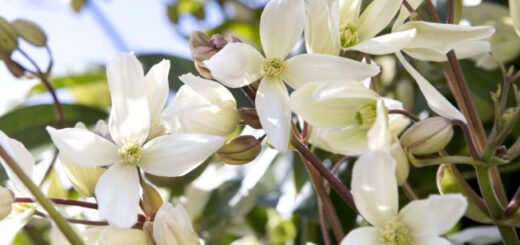
Fast growing climber for a pergola is clematis armandii it’s evergreen fast growing and has a great show of flowers in the late spring. It’s a plant that’s happy in heavy soil and as it requires quite a lot of water in the spring because of it’s speed of growth

→ No CommentsTags: Uncategorized

Black spot on container roses

July 1st, 2010 · No Comments

Black spot on container roses the best course of treatment is to remove the infected leaves plus any fallen leaves around the base. You can spray with a fungicide available from a garden centre. Then in the winter prune the rose back remove all the leaves including the fallen ones and spay the plant with jeyes fluid a weak mix with water then finally add a mulch around the base of the plant such as fresh compost or bark this helps stop the black spot spores getting splashed back onto the new foliage from the soil in the

→ No CommentsTags: Uncategorized

Tree fern problems after the hard winter

July 1st, 2010 · No Comments

Tree ferns – loads of them have been effected by the winter this year. If you have a feel around at the top and see if you can feel the buds which should be firm and green if they do not exist or or brownish or soft then it’s likely the fern has been killed by the hard weather. It will be worth waiting for a time as some times they can recover unlike a lot of garden plants they will not create shoots from lower down the stem. However if your tree tern has a large stem it might be possible to transplant a small fern onto the top of this existing stem.

→ No CommentsTags: Uncategorized

Lilly beetles

July 1st, 2010 · No Comments

Lilly beetles we deal with ours by treating the plants with derris dust
which is an organic insecticide plus we place yellow buckets of water near the
plants and the beetle for reasons that are unclear to usthe lilly beetlesjump into the buckets
it only seems to work with yellow buckets.

→ No CommentsTags: Uncategorized

clover in Lawn

July 1st, 2010 · No Comments

Clover in your lawn you need to treat it with a weed killer called verdone which is the strongest chemical available for this purpose. The clover has a waxy leaf
so will need treating several times through the summer months.Ideally you should cut the lawn leave for 4 days and then apply
This is because the chemical will find it easier to enter the young leave of the clover which as softer and less waxy.

→ No CommentsTags: Uncategorized

Snail problem

July 1st, 2010 · No Comments

Every one is always complaining about slugs but in some cases especially in chalk soil area its not slugs that are the problem but snails. Often the advice we provide for such a snail problem is more on the prevention and cultural methods of control.  Snails are a stable food of many larger birds such as black birds and thrushes so by encouraging them to your garden with regular feeding you tend to solve the snail problem at the same time.  Many larger birds especially thrushes have learned how to use large stones as tools to break the snails shells. so its worth leaving some large flat stones around the garden to be used by the birds to crack the thin snail shells.

→ No CommentsTags: Uncategorized

Best time to use a lawn weedkiller

July 1st, 2010 · No Comments

The best time to use lawn weedkiller is in May, when plants are growing at their fastest rate, particularly if you are using Verdone or a dry phosphate. All plants have a chemical growth clock which will stop them from outgrowing themselves. Verdone, for example, contains 2-4-D, which alters the growth clock so that the plant will outgrow itself at such a rate that it will collapse (a bit like an overdose of steroids). It will shoot up and look very healthy, but will die after about three weeks.
You need to be assured of six hours dry weather so that it gets absorbed into the leaf and not washed away by rain. It is best to apply it from a can with a very fine rose (such as a Hawes watering can which have extremely fine roses), which will allow the droplets to stay on the leaves for quite a while. This is better than using a spray which could drift and kill plants that are not weeds.

→ No CommentsTags: Uncategorized